Jankiel
The PeasantsJankiel, the Jewish innkeeper of Lipce, occupies a consequential place between the village’s economic life and its social margins. His tavern supplies drink and credit, circulates news, and brings him into contact with farmers at moments of celebration, poverty, and political dispute. He is a familiar neighbor, born in Lipce to a family established there for generations, yet the villagers’ language repeatedly marks him as an outsider. The tension between that exclusion and his practical commitment to the community gives his recurring appearances their force.
Identity and Place in Lipce
Jankiel has lived in Lipce for a long time and runs the village inn. The narrative’s commentary notes that villagers chiefly identify him as a Jew rather than by his personal name, a pattern that persists even as he appears in the ordinary routines of village life. His position is therefore both central and peripheral: people rely on the tavern and its owner, but familiarity does not guarantee acceptance.
The inn is a place of business as well as conversation. Jankiel serves customers, extends or withholds credit, and hears news quickly. When word spreads that the miller’s horses have been stolen, a villager reports that Jankiel has already told Mateusz. The exchange treats his knowledge as immediate and dependable, making him an informal point in the village’s network of information.
Trade, Credit, and Practical Assistance
Jankiel’s dealings are concrete and carefully calculated. When Kuba comes to the inn, Jankiel is sitting at the bar in his shirtsleeves and yarmulke, stroking his grey beard and reading with his eyes close to the page. Kuba hesitates while counting his money; Jankiel waits, then enters into a hunting arrangement with him. He offers ten groszy for each partridge, promising payment in drink and food as well as cash. When the conversation turns to larger game, he proposes supplying a shotgun and powder, offers a rouble for a deer, and specifies that Kuba must cover the powder costs and make good any damage to the gun with oats. The terms show Jankiel as a shrewd trader, attentive to both the opportunity and the risks of the exchange.
The arrangement also places Jankiel between Kuba and the means to hunt. He does not merely buy whatever Kuba happens to bring in: he proposes the equipment, sets the prices, and defines the conditions. At a village celebration, he slips away before the musicians can provide the Jewish tune the crowd has requested, going instead to see Kuba and collect the shotgun. The business continues quietly alongside the public revelry.
Credit becomes more fraught in the household of Antek and Hanka after they are expelled from Boryna’s homestead. They are living on potatoes and salt, with almost no money, and Hanka says even Jankiel will not extend further credit. His refusal gives their hardship a material boundary: need alone cannot keep their account open. Yet his relation to Hanka is not reducible to that refusal. When she brings money to the inn, he helps her count it by the hanging lamp, offers her vodka, and does not tell her about Antek’s debt. He asks what Antek is doing, then points out that there is work available: a sawmill is being built at the miller’s, and Jankiel himself needs help carting timber. His discretion and offer of work are practical interventions, though Hanka rejects the idea that her husband would work for the innkeeper.
A Neighbor Among the Celebrants
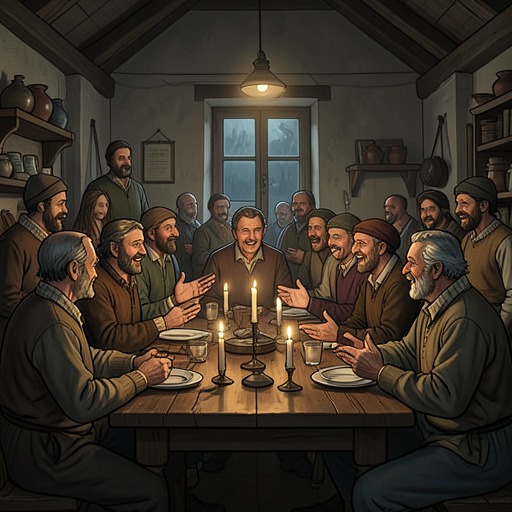
Jankiel appears regularly in collective gatherings, but his inclusion is conditional. During a wedding celebration, he is drawn from the hallway into a room full of farmers and greeted amiably by some, while insults are also thrown at him. The Voyt calls for the abuse to stop and offers him vodka. Jankiel accepts a drink and proposes drinking to the couple’s health. The exchange lets him participate in the celebration, while the insults and jokes about Jewish food and dance keep his difference in view. Before the musicians can respond to the demand for a Jewish tune, he slips away without drawing attention.
At another crowded gathering, Jankiel moves quietly among the drinkers, setting down more vodka and beer and marking on the door who owes what. As the villagers drink, embrace, and celebrate, his work remains a counterpoint to their fellowship: he makes the conviviality possible while keeping its debts visible. He is not simply an observer outside the room, nor does the scene present him as one of the revelers on the same terms. His place is that of an indispensable service provider whose presence does not dissolve the social distance around him.
His business also brings him into less celebratory encounters. When Antek sits drinking while Boryna has gone ahead to court in a case against the manor, Jankiel explains where the crowd is headed and what the lawsuit concerns. Later, when Antek tries to leave without paying, Jankiel blocks the way and insists on payment, stating that he will not give credit. Antek threatens him, and Jankiel pales and steps aside. The moment makes the imbalance plain: he can enforce an account in the inn, but his authority is vulnerable to a customer’s violence.
Solidarity and the Limits of Belonging
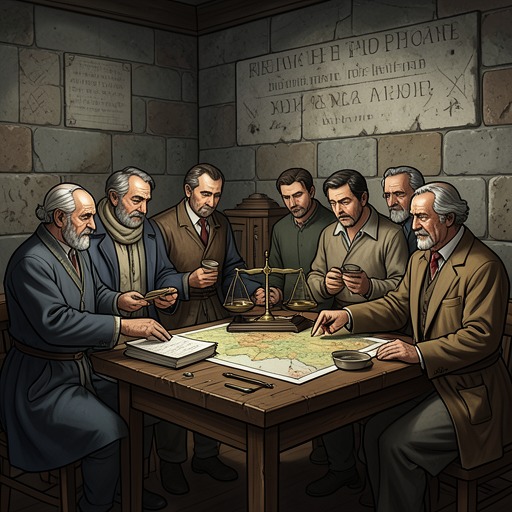
Jankiel’s clearest political intervention comes when the villagers discuss the German settlers at Podlesie. Mateusz’s counsel has already shaped the conversation when Jankiel enters with a bottle. He cautiously endorses Mateusz’s judgment, prompting astonishment from the farmers that a Jew should side with them. Jankiel explains that he prefers to stand with his own: he shares their misery, and German settlement threatens not only the poor Jewish trader’s livelihood but also the village’s. He says he was born there, as were his father and grandfather, and argues that the farmers’ well-being and his own are connected. If they can continue as farmers, he can continue trading with them.
The speech grounds solidarity in shared place and mutual economic dependence, rather than claiming that religious difference has disappeared. Jankiel supports the villagers’ plan and offers them a bottle of arak; the group seats him among them and seeks his advice. The response is a temporary movement from surprise to fellowship, not proof that prejudice has ended. Elsewhere, a later quarrel over the proposed settlement with the manor grows loud enough for Jankiel to bring a stout bottle to the table. He urges accord and imagines Podlesie becoming a new Lipce, with each man able to hold a respected position. His recurring use of drink in such disputes is simultaneously commercial and communal: he sells the means of conviviality and tries to turn it toward agreement.
Narrative Significance
Jankiel’s recurring presence makes visible the distinction between economic participation and social belonging. The villagers trade with him, depend on his information, and gather in his inn; they may nevertheless call him by a religious label, insult him, or express surprise when he identifies with their interests. The narrative’s commentary situates this friction within the economic and religious forms of rural anti-Jewish prejudice, while distinguishing that older village hostility from the later political nationalism that would recast Jews as enemies of Polishness.
Against that emerging stereotype, Jankiel’s own account of belonging is specific: his family has roots in Lipce, his livelihood is bound to its farmers, and the fate of the community affects him too. His role does not make him a political leader, and the evidence does not suggest that he overcomes the vulnerability attached to his position. Rather, he repeatedly acts within the relationships available to him—as innkeeper, lender or creditor, buyer, employer, news-bearer, and neighbor. The gap between how much the village uses his services and how incompletely it recognizes him is the defining tension of his character.